Addition of Dichloroketene to Styrene; Cyclobutanones SyntheticPage 208 (2002)
Submitted 29th Oct 2002, published 5th Nov 2002
Colin Morton
([email protected]),
A contribution from the Scott Group, Warwick
Chemicals Used
Styrene (Aldrich, distilled), Zinc dust (Aldrich),
Copper Sulfate hydrated (Aldrich), Diethyl Ether (Aldrich, dried over Na/K alloy), Trichloroacetyl Chloride (Aldrich), Phosphorous oxychloride (Aldrich, under Argon)
Procedure
Activation of Zinc: Zinc (20 g) was stirred in 20% HCl for 15 mins. After filtration it was washed with water (50 ml) and acetone (50 ml) and dried in vacuo.
Zinc/Copper Couple: A stirred suspension of activated zinc (10 g) in water (40 ml) was degassed by bubbling N2 through it for 1 hr. To this was then added CuSO4.5H2O (1.18 g). The resulting black suspension was stirred for an extra 3 hrs with bubbling N2. The Zn-Cu couple was collected on a sintered funnel and washed with water (100 ml) and acetone (100 ml) and dried in vacuo. The couple was stored in a dessicator over silica gel.
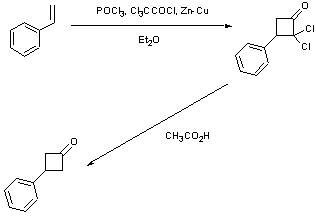
2,2-dichloro-3-phenylcyclobutanone: To a dry 2 necked 50 ml RBF under Argon was added styrene (1.1 ml, 9.6 mmol), Zn-Cu Couple (0.69 g, 10.5 mmol) and anhydrous Et2O (20 ml). To this was added a solution of Cl3CCOCl (1.1 ml, 10.0 mmol) and POCl3 (0.92 ml, 10.0 mmol) in Et2O (20 ml) over 1 hr. The resulting mixture was then refluxed for 4 hrs. The suspension was then filtered through a pad of celite which was subsequently washed with bench Et2O (50 ml). The organic solution was then subsequently washed with water (100 ml), saturated NaHCO3 (50 ml), brine (50 ml) and water (50 ml). Separation from the aqueous phase and removal of all volatile organics gave a yellow oil that was purified by trap-to-trap distillation (90oC, 10-3)to give a white crystalline solid.
Yield 1.6 g, 77%.
3-phenylcyclobutanone: The halogenated product above was heated in glacial acetic acid (30 ml) for 2 hrs. Standard aqueous work-up and purification by trap-to-trap distillation (85oC, 10-3) gave a clear colourless oil.
Author's Comments
It is worth activating the zinc before making the Zn-Cu couple-it really makes a difference.
Data
3-phenylcyclobutanone
(CDCl3) 7.2-7.5 (m, 5H), 3.2-3.7 (m, 5H).
Lead Reference
J.Org.Chem., 43,1978,2879
J.Org.Chem., 48,1983,3382
Other References
This page has been viewed approximately 864 times since records began.
Get CDX file (Choose "Open this file from its current location" TWICE)
SyntheticPagesTM are for use
exclusively by those with training and experience in synthetic chemistry. While contributors
are asked to identify hazards and to use methods designed to reduce risk, no formal hazard
or risk assessments are included, and these procedures must be conducted at one's own risk.
SyntheticPages, its editors, owners and associates do not warrant or guarantee the safety of
individuals using these procedures and hereby disclaim any liability for any injuries or damages
claimed to have resulted from or related in any way to the procedures herein. Copyright ©2004 Synthetic Pages
User comments on this page |
Professor T.K.Raja
Fri, 13th Feb 2004 04:43:02 |
Excellent method. |
Comment on this page!
Registered users may add comments to other pages. If you have already registered, please
log in, otherwise you may
register here.
|